Extraordinary Animations: Corrie Francis Parks joins the Academy of Motion Picture Arts and Sciences
Corrie Francis Parks, professor of visual arts, is an inventor of animation techniques whose short films have been screened at major festivals around the world. Her numerous awards and honors now include a major addition: This past summer, she was elected to the Academy of Motion Picture Arts and Sciences, known especially for the annual Academy Awards.
Parks has been creating animation since her teenage years. She designed her own major in animation at Dartmouth College and subsequently received her M.F.A. in animation and digital arts from University of Southern California. At UMBC, she encourages animation students to expand their understanding of the art of movement.
Her book Fluid Frames: Experimental Animation with Sand, Clay, Paint and Pixels explores the tactile nature of moving malleable materials directly under the camera, bringing together traditional and digital workflow through interviews with contemporary animators and workshop-style exercises.
Below, Parks shares what it means to become a member of the Academy, talks about her artwork, and chats about teaching and the Baltimore arts scene.
Q: What does it mean to be recognized by the Academy at this point in your career?
A: As an independent filmmaker it is an incredible honor to be invited to the Academy. My work explores experimental production methods and non-narrative structures, so to have this sort of research recognized alongside large-budget commercial productions is really encouraging, both for me personally and for the field. In recent years the Academy has been diligent and intentional about diversifying its membership in all aspects to better represent the art of cinema and including more artists who make experimental and independent films is part of that initiative.
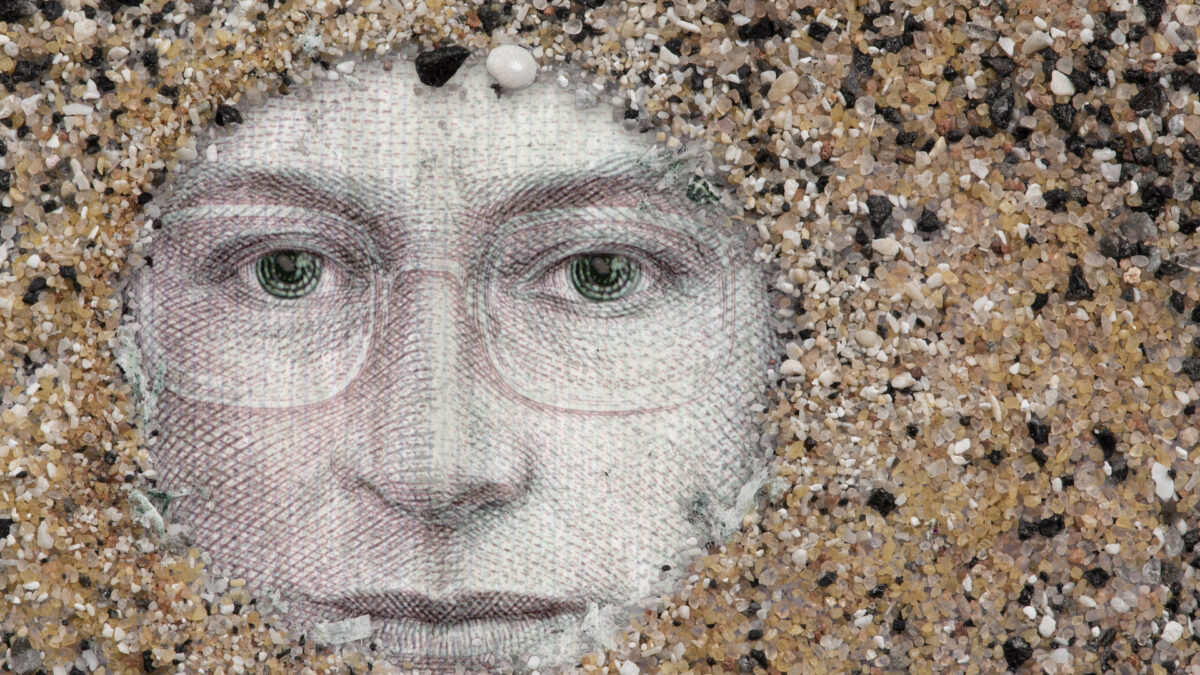 A still frame from Parks’s 2019 film Foreign Exchange. (Courtesy of Parks.)
Q: As a visual artist, was stop motion animation your first love? What inspired or excited you about it?
A: I actually first fell in love with hand-drawn animation and originally wanted to work on Disney and Pixar films. I studied character animation and how to break down movement to make anything—drawings, puppets, objects—come alive. In the process of making films, I discovered I really liked inventing new ways to use materials and find a unique “look” for my films. There’s a problem-solving and engineering aspect to stop-motion since I am working in physical space and with dimensional materials. I find those limitations help shape the animation and help me make decisions.
Q: How would you describe your work to someone unfamiliar with it, and where would you suggest they begin?
A: I would say I am an animation artist who makes both short films and projection-based installations. I began working with sand as my primary material in 2002 and continue to find new ways to use it, especially combining shooting stop motion with digital post-production. This means each project has its own style, so a good place to start is with one of my early films, A Tangled Tale, and then to see how I approach the material differently in later films like Foreign Exchange or some of my installations. Seeing installation and projection mapping works are harder because they exist in a physical space for a limited time, but would give a viewer a different understanding of how animation can work in a non-linear setting. Most of my films and other work are documented on my website.
Q: The stop-motion animation in Foreign Exchange requires tiny, intricate movements of grains of sand, while similarly in SKRFF you cut through layers of paint. What are the most significant challenges for you as you create?
A: Animation does take great patience but it is also always moving forward, so for me quickly going from one frame to the next is much more engaging than spending hours on a single painting or drawing! As I have become more interested in applying animation principles to new materials, like a graffiti wall in SKRFF or tiny grains of sand in Foreign Exchange, I have found my work becomes less narrative, so the challenge for me is to determine an underlying structure. Often that comes from the music or sound design, as it did in both these films.
There are technical challenges as well—having the right camera lens, lighting, and computer power to make the work efficient. I’m lucky to be able to work with my husband, Thom Parks, who is the technical director on most of my projects and he really keeps the studio running very smoothly!
 In the studio, Parks manipulates grains of sand as she creates an animation. (Courtesy of Parks.)
Q: Sound is clearly an important component of your work. How do you select and work with a sound artist?
A: The collaborations have happened naturally and oftentimes are shaping the project from the very beginning. In Foreign Exchange, the driving musical track is a piece by Baltimore composer Alexandra Gardner. Alex and I met many years ago at the MacDowell colony and eventually both ended up in Baltimore. We had wanted to collaborate for some time so when I was exploring micro-sand animation, she gave me some of her music to play around with. Eventually we settled on Tourmaline and Alex re-worked her composition to fit the length and structural arc I was aiming for. The sound effects and mixing were all done by Matt Davies at Studio Unknown, a fantastic sound design studio in Catonsville.
For SKRFF, since the film was shot in Vienna, Austria, we asked Sandro Nicolussi, a sound artist we had met at another residency earlier that year. My collaborator on the film, Daniel Nuderscher, had worked with Sandro previously and we both felt his sound aesthetic would really fit the footage we were creating on the graffiti wall. As I was editing the footage, I would send pieces to Sandro, and he would send segments of sound back and we went back and forth letting the film develop in an organic way.
 A still frame from SKRFF, created in 2024. (Courtesy of Parks.)
Q: What do you love about teaching, and what’s it like in your classroom?
A: I do love teaching, especially challenging students to expand their artistic process and try new techniques. My classroom involves a lot of student-to-student conversation, with a bit of guidance from me—because I think learning how to articulate and analyze your own work and that of your peers is essential to the artistic process. The most impactful teachers in my life were the ones that interacted with me as artist-to-artist, and showed me films or gave me assignments that were somewhat uncomfortable. That’s how we all grow beyond the limits we impose on ourselves.
Q: Can you tell us about UMBC’s connections to the Baltimore arts community?
A: I think a great asset to our students is how engaged our arts faculty and staff are with what’s going on in Baltimore. We are always showing or performing work somewhere nearby, so students can see what it’s like to be a practicing artist in a community. I love that some of our students have taken over the first floor hallway in the Fine Arts Building and are making it an exhibition space for their own work.
Q: Your work with sand has lots of quirky playfulness to it—things that would make people smile. Do you think about that as you’re creating new work?
A: I make work that makes me delighted and that I find interesting to watch! Animation is always a bit magical, because it’s breathing life into something that shouldn’t be alive. I guess if it works for me it works for other people too!
Q: What’s next for you? Can you share anything about works in progress?
A: I have a new film in the works, based on writings and discoveries made by early microscopists, Antonie van Leeuwenhoek and Robert Hooke. I’m animating grains of sand as though they were microscopic organisms inhabiting their own cosmic worlds, waiting to be discovered and explored.
 Parks works on an animation in the studio. (Courtesy of Parks.)
Posted: September 8, 2026, 9:27 AM