Could a smartphone take the place of expensive medical equipment? Dong Li investigates how to make affordable health monitoring accessible
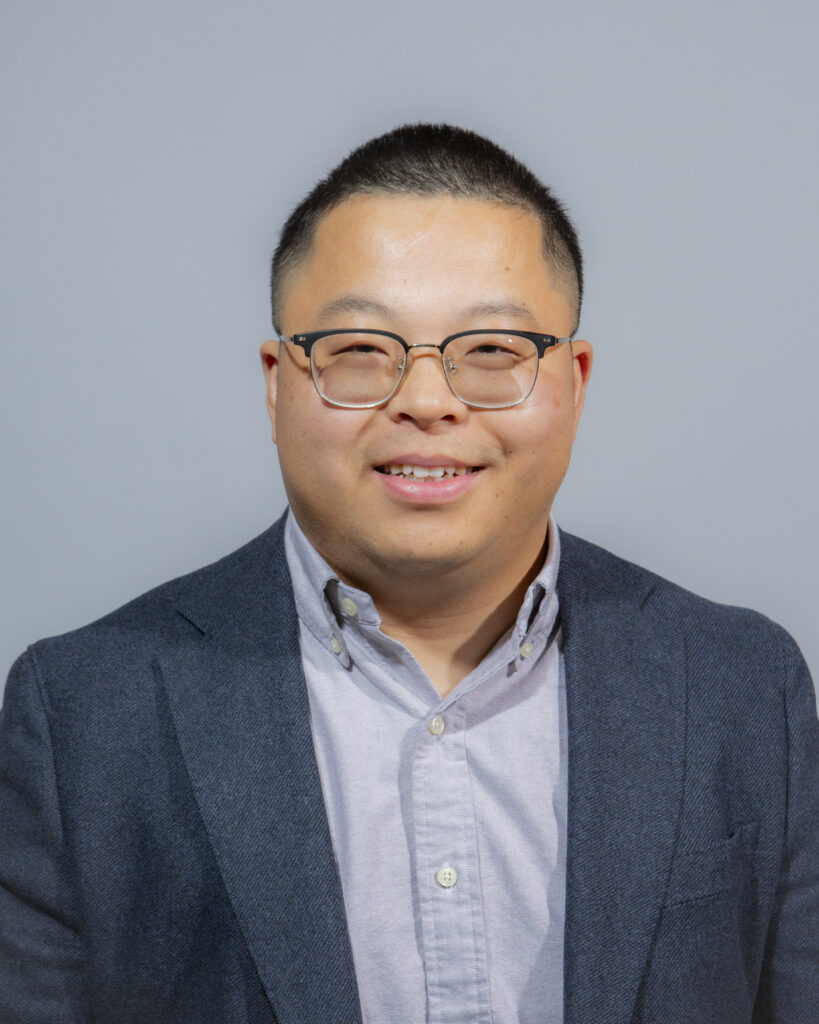 Dong Li (Photo courtesy of Li)
A common saying is “Health is wealth.” Its meaning—that good health gives people the vitality to succeed in life—is found in stories and phrases across cultures and times. Dong Li, an assistant professor in the Department of Computer Science and Electrical Engineering, has long nurtured an interest in helping people stay in good health, from his early childhood interest in becoming a doctor to his current research focusing on developing cost-effective and widely accessible health monitoring technologies.
As the founder and director of the Future Sensing and Interaction Lab, Li studies how affordable devices, such as smartphones and watches, can monitor general health indicators, vital signs, and physical activities. Li also explores how to build innovative computer-human interfaces to deliver an intuitive user experience. His goal is to use the advanced sensing technologies on many smart devices to help people improve their well-being.
“I am a tech believer,” Li says. “Technology has enormous potential to make change, and that’s why I have devoted my efforts and my time to try to develop applications of technology that benefit society.”
Li shares here about his work, its challenges, and his hopes for a world where healthcare is both affordable and accessible.
Q: What are your main areas of research?
A: My main area of research is what we usually call mobile health, or mHealth. The goal is to make health intelligence more accessible by using everyday devices that people already have, such as smartphones, earphones, smartwatches, and even smart rings.
For example, in several projects in my lab, we’re exploring ways to measure things like blood pressure and skin stiffness using a smartphone. One way to think about it is this: as human beings, we have eyes, ears, and a nose that help us sense the world around us. So what if we could use our smartphones as an additional sensing tool—not just to understand our environment, but to sense what’s happening inside our own bodies, such as blood pressure, heart rate, respiration rate, and other physiological signals?
The second part of my research focuses on AI. We’re interested in building AI models that can use data collected from these everyday devices to detect signs of disease at an early stage. Large language models like ChatGPT, for example, are trained on huge amounts of language data. In a similar way, we can train health-related AI models on large amounts of physiological data collected from devices people use in their daily lives. The question is whether the model can learn subtle patterns in that data that may indicate the early stages of disease.
The third part of my research is about security and privacy. If we’re collecting sensitive health information, we need to make sure both the AI model and the overall system are secure, and that people’s private information is protected.
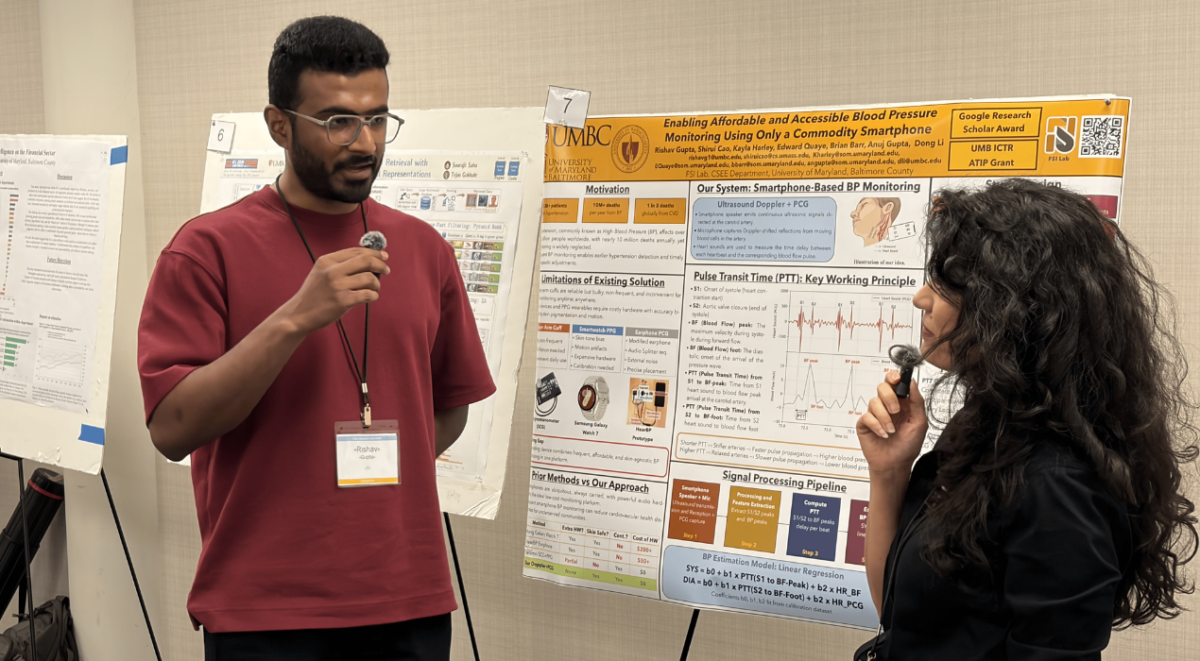 Ph.D. student Rishav Gupta is working with Li. Here he presents the research at UMBC COEIT Research Day 2026. (Photo courtesy of Gupta)
Q: What motivated you to get involved in these areas of research?
To be honest, when I was in primary school, my dream was to become a doctor. But somehow, I ended up choosing computer science as my major.
After I completed my Ph.D. at the University of Massachusetts Amherst and joined UMBC as a faculty member, I learned about opportunities for internal research funding and collaboration between UMBC and the University of Maryland, Baltimore, which has long-established professional schools in areas such as medicine, dentistry, pharmacy, and nursing.
When I heard about those opportunities, I immediately thought, “Okay, this is my chance to reconnect with that childhood dream.” I realized I could combine my background in computer science with healthcare and work on interdisciplinary research that could have a real impact on people’s health.
So in a way, I didn’t become a doctor, but I found another path that allows me to contribute to medicine through technology. That’s really what motivated me to move into this area of research.
Q: How do you hope the research will impact ordinary people’s lives down the road?
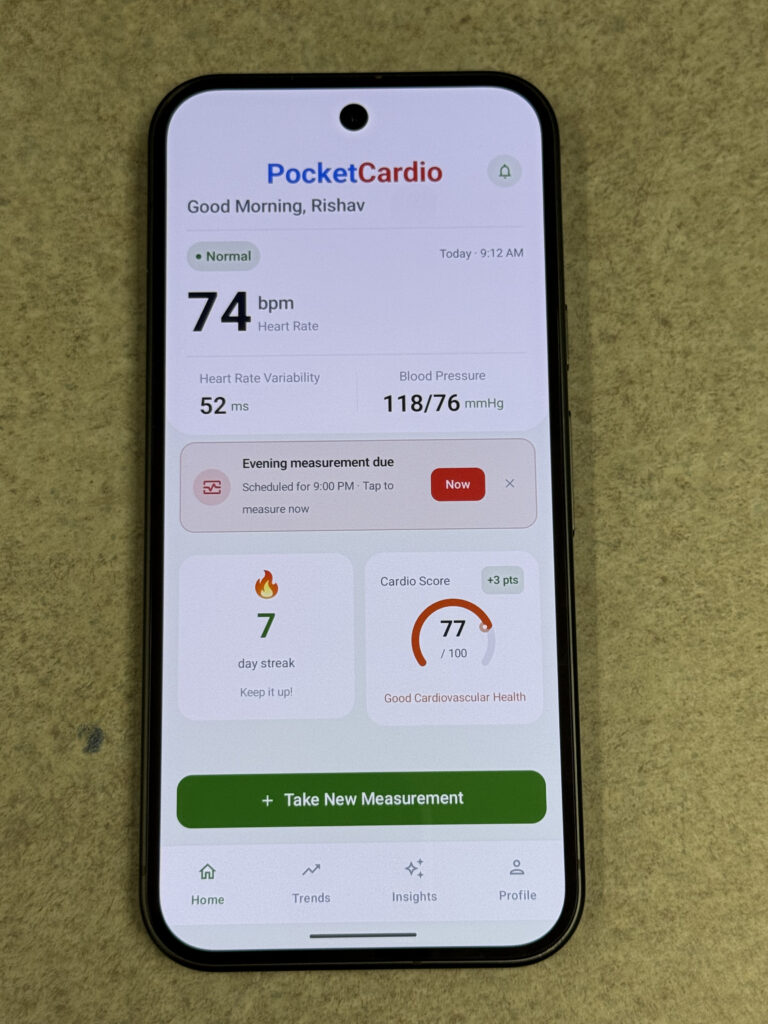 Li and Gupta have created an intuitive interface for the blood pressure monitoring PocketCardio app. (Photo by Ramya Bommakanti)
Our long-term vision is to make health monitoring more accessible and affordable for everyone. Right now, if we want to monitor certain aspects of our health, we often have to go to a doctor for regular examinations or use specialized medical equipment, which can be expensive and may not be easily available to everyone.
What we hope to do is bring some of that monitoring capability into the everyday devices people already use, such as smartphones, earphones, smartwatches, or even smart glasses. Instead of relying only on specialized equipment, people could potentially use these familiar devices to better understand and monitor their health in their daily lives.
If our research is successful, we hope it can give people a simple and convenient way to keep track of their health, identify potential problems earlier, and make more informed decisions about when to seek medical care. Ultimately, the goal is to use technology to help people live healthier lives.
Q: What are the biggest challenges that the research will need to overcome to reach these goals?
The most challenging part is not technical. What I realized when I talked to the clinical doctors from UMB School of Medicine is that the challenge is how to make people aware of this development. The challenge is assuring people of data security. People ask questions like, “What about privacy? How can you make sure you don’t leak our private information?” I think that’s the biggest challenge we will have if we want to make this a product that everybody can benefit from: How can we communicate about the technology so that people can understand it and are willing to use our product in the future?
Q: Do you have any recent results that you are especially excited about?
Yes. We are doing the clinical trials for our blood pressure monitoring project. We have collected data, I believe, from 30 healthy subjects right now, and we are in the process of collecting data from hypertensive patients at the hospital. The data we have right now shows very promising results, and I’m very excited to see if our prototype can work for those hypertensive patients. If it does, I think our next step is that we could do a wider deployment to verify our system. I attended the Maryland NEW VENTURE program [an intensive 12-week accelerator run by bwtech@UMBC that helps early-stage technology founders]. I shared this story with a lot of our investors, and they are super excited about this product. Maybe sometime next year, we will establish a startup company to make it a real product to benefit ordinary people.
 Li (center), Gupta (left) and other members of the PocketCardio team won first place at the Maryland NEW VENTURE pitch competition. (Photo courtesy of Li)
Written by: Ramya Bommakanti, a senior information systems major and communications intern in the COEIT Dean’s office.
Posted: August 18, 2026, 4:25 PM