There’s nothing secret about David Mountain’s love of learning
David Mountain, Ph.D. ’17, computer engineering, can’t tell you much about his job. It still sounds exciting. As a researcher at the National Security Agency (NSA)—sometimes jokingly called the “No Such Agency” because of its top secret signal intelligence and cybersecurity work—Mountain worked to develop groundbreaking computing technology over a career spanning more than four decades.
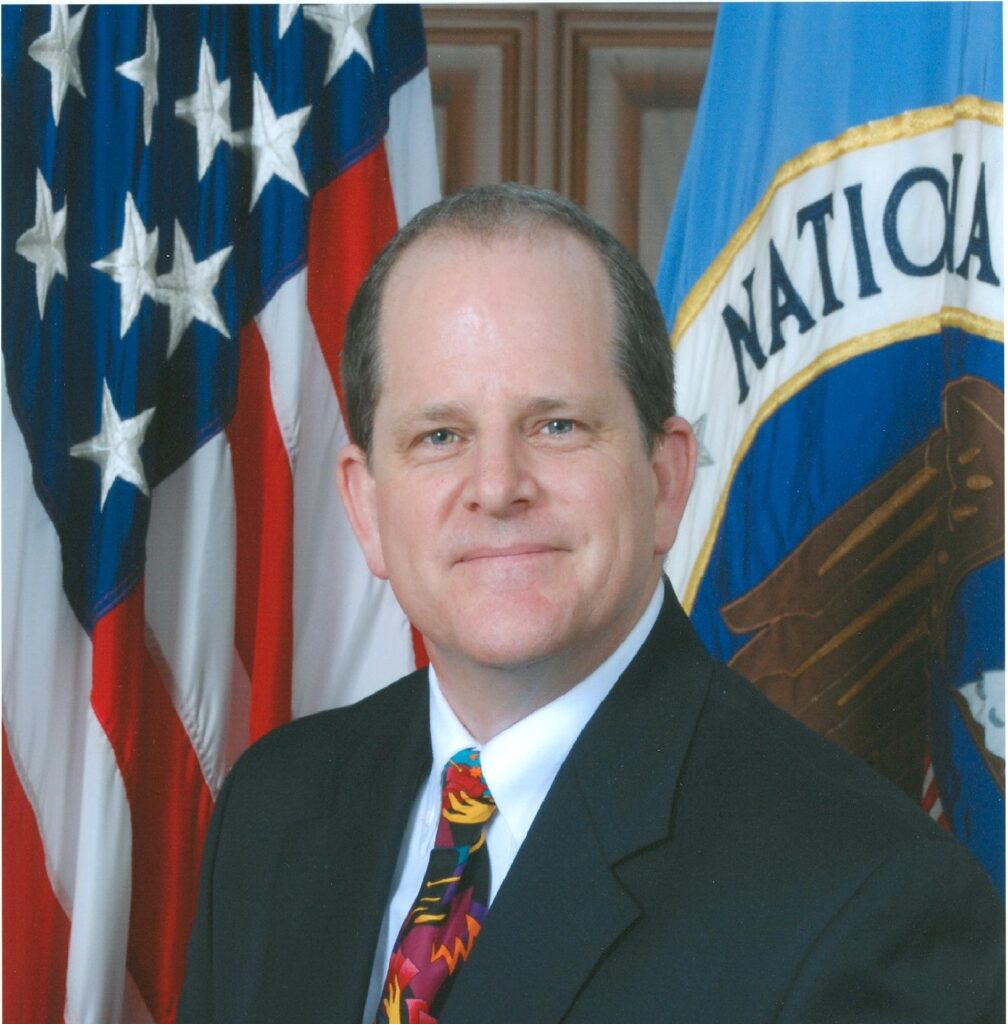 David Mountain worked his entire career for the U.S. National Security Agency. (Photo courtesy of Mountain)
“The most fun projects started with an operational organization [within NSA] asking us, ‘Can you do this [perhaps wild-sounding] thing?’ and ended with them telling us they fielded the devices we built and they are working great,” he says.
Pop culture often portrays the NSA as a shadowy spy agency. From Mountain’s perspective, his job was not the thrilling escapades of James Bond, but had a certain resemblance to the high-tech wizardry of Q, who supplies Bond with his cool gadgets. Mountain’s colleagues were curious people who loved tackling hard science, math, and engineering problems. Add to that the mission of protecting U.S. national security and it equaled a fulfilling work environment.
Looking back, Mountain splits his career into two approximately 15-year blocks, the first spent “doing really hardcore technical stuff,” from which he earned numerous patents, and the second half coordinating the work of technical teams and mentoring the next generation of researchers. Along the way, he also spent multiple years taking advantage of NSA internship and development programs.
Sometimes Mountain’s work did see public light, such as his research into building flexible electronics, with applications in “smart” clothing, autonomous vehicles, solar panels, and more. The research was shared with industry through the NSA’s Technology Transfer Program.
Now (mostly) retired, Mountain says the best part of his job was the opportunity to constantly explore new topics and take on new challenges.
“The government was really good about education and developing people, and I took full advantage of that,” Mountain says. “I got paid to learn new things, and that was great.”
Imagining a new type of computer hardware
It was the love of learning that brought Mountain late in his career to UMBC as a Ph.D. student. He had already made use of NSA programs to earn his master’s degree in electrical engineering from the University of Maryland, College Park, and to take research sabbaticals. After enrolling as a UMBC student in 2014, Mountain worked with his advisor Anupam Joshi, a computer science and electrical engineering professor and now the university’s chief A.I. officer, on a Ph.D. dissertation exploring a concept called neuromorphic computing.
In neuromorphic computing, researchers take inspiration from the human brain to reimagine traditional computing hardware. While traditional computers perform data processing and memory operations in physically separate units, neuromorphic systems merge the functions at artificial “synapses.” Neuromorphic systems also generally trigger calculations when they receive an input signal, rather than performing operations at regular, clock-based intervals. These changes improve computers’ energy efficiency and adaptability when applied to most AI tasks today, such as image and speech recognition.
For his Ph.D., Mountain analyzed a new type of electrical circuit building block, called a memristor, that shows promise in neuromorphic computing. Mountain explored how arrays of memristors divided into small chunks, or “tiles,” could be flexibly combined to handle a variety of tasks, including recognizing hand-written digits and detecting malware. The conclusion, Mountain says, was that with additional hardware improvements it should be possible to build a general purpose neuromorphic computer—similar to our general purpose personal computers of today—that could handle a wide variety of tasks with both high performance and energy efficiency.
Mountain was drawn to UMBC for his Ph.D. in part because of its close proximity to where he worked in the Advanced Computing Systems group of the NSA’s Laboratory for Physical Sciences, located at the bwtech@UMBC Research and Technology Park. The Laboratory for Physical Sciences is a partnership that the government runs with industry and university partners to advance research in communication, sensing, and computer technologies. Prior to beginning his Ph.D. work, Mountain had developed many positive relationships with UMBC faculty and students, including collaborating with Matthias Gobbert, a professor of mathematics and statistics at UMBC, on several high-performance computing research projects for undergraduate students, funded by the National Science Foundation.
During his Ph.D. research, Mountain took numerous UMBC graduate courses, and credits computer science and electrical engineering professor Fow-Sen Choa and associate professor Ryan Robucci with providing valuable guidance and support that shaped his research.
“I was a non-traditional student and everyone supported me in that,” Mountain says.
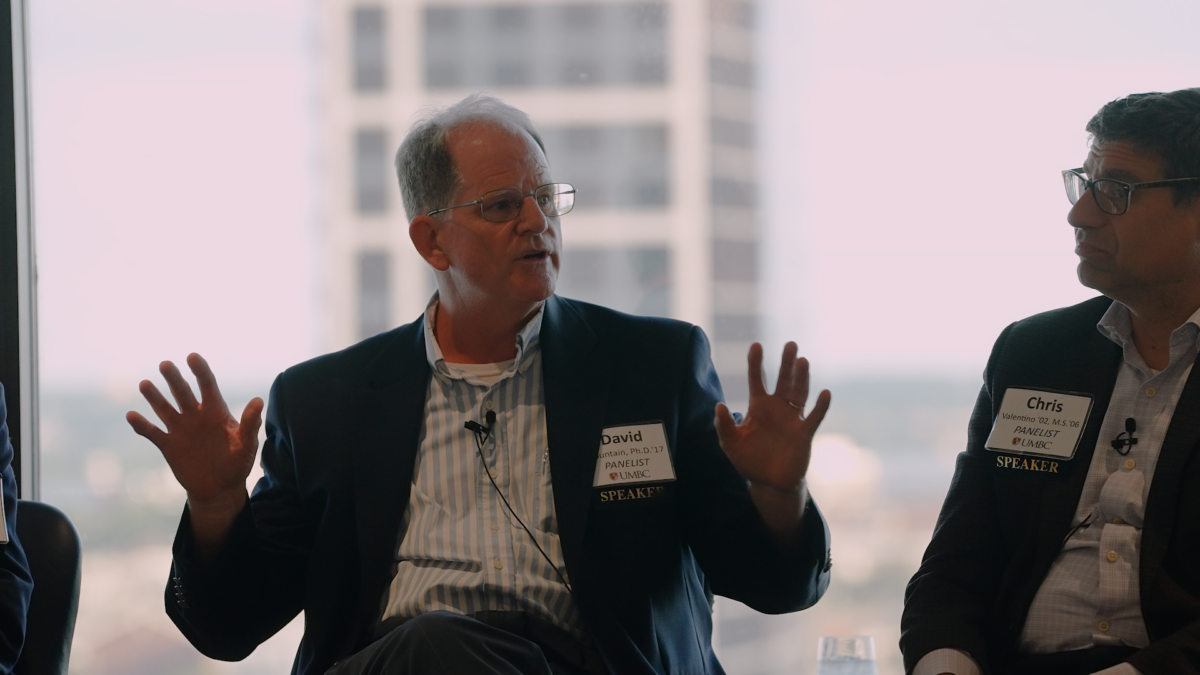 David Mountain (left) speaks at the Hilltop Society’s event “Artificial Intelligence: Making Our Lives Healthier, Safer, and More Efficient,” held at the The Center Club in Baltimore. (Elijah Davis, M.F.A. ’21/UMBC)
“David is super smart and well respected,” Joshi says. Joshi’s own Ph.D. thesis explored how computers might learn like biological brains, specifically examining how a type of machine learning approach called neural networks could be organized in a similar way to the early stages of human’s visual processing system. “With David, the research came full circle,” Joshi says. “I looked at how biology could be emulated in software. David was looking at how to create the hardware.”
Staying connected and giving back
Mountain lives in the southwest Baltimore neighborhood of Ten Hills, a 10-minute drive from the UMBC campus. Since graduating with his Ph.D., he has served on the advisory board for the Department of Computer Science and Electrical Engineering, networked with students at various career-focused events, and developed and taught a graduate level quantum computing course, designed to help build the quantum workforce by providing computer scientists and engineers with an accessible introduction to core quantum computing concepts.
On May 28, Mountain served as an expert panelist at an event organized by the Hilltop Society exploring how AI can create a healthier, safer, and more efficient future. He was joined by Jennifer Sleeman, Ph.D. ’17, computer science, a senior AI research scientist at The Johns Hopkins Applied Physics Laboratory, and Chris Valentino ’02, M.S. ’06, information systems, the vice president of cyber and information solutions at Northrop Grumman.
Enjoying semi-retirement with his wife, Diane, with whom he raised four children, Mountain now regularly travels, visits the theatre and museums, and takes the occasional consulting gig. “My wife and I joke that we have become wise asses on the hill,” he says. He’s happy to dispense opinions on the future of computing and AI, the prospects of data centers in space, and more. Just don’t ask him too much about what he did for a living.
Posted: August 13, 2026, 9:30 AM