With great scientific powers comes great responsibility: Mercedes Burns, arachnid researcher, reviews “Spider-Man: Brand New Day”
Spoiler alert!
The first Spider-Man movie with Tom Holland as Peter Parker, “Homecoming,” was released almost a decade ago in 2017. Mercedes Burns, associate professor of biological sciences and Spider-Man fan, has been studying arachnids for double that. This summer’s blockbuster, “Spider-Man: Brand New Day,” shows Peter Parker slowly becoming an actual spider as the result of hormonal imbalances triggered by extreme stress, trauma, and long-term social isolation. He produces organic webbing, his eyes turn pitch-black, his “Spidey senses” are enhanced, and biological web slingers develop in his wrists for close-quarters combat. Burns, who wore her spider taxonomy t-shirt to the movie, will tell us if these upgrades have any scientific merit.
Q: What was your first reaction to the movie, particularly from a scientific perspective?
A: I enjoyed the movie, though I preferred 2021’s “Spider-Man: No Way Home.” I thought the new movie was a little uneven scientifically. Some things were extremely technical and accurate, while other things were vague. I did some research on the vague hormone discussion, to try to understand why that aspect was much less specific than some of the other science in the movie.
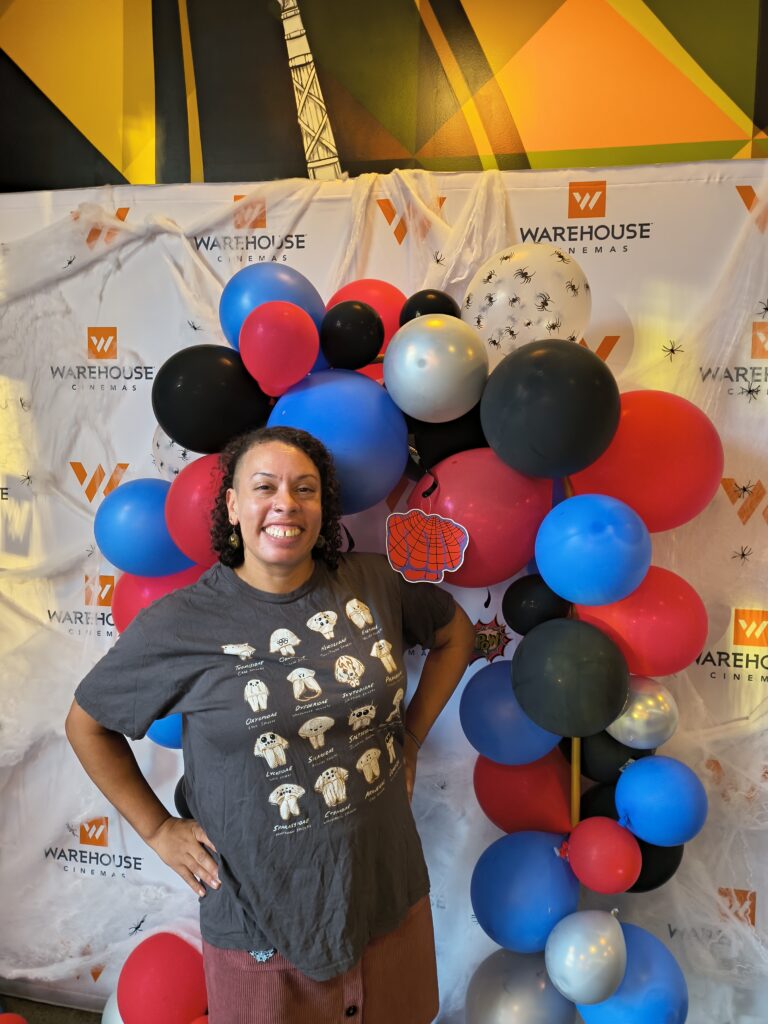 Mercedes Burns wore her spider taxonomy t-shirt to the new Spider-Man movie. (Courtesy of Burns)
There was a piece in the trailer where Bruce Banner, the Hulk—portrayed as a physics professor at the fictional Empire State University—explains the life cycle of the spider that did not make it into the movie. So there was no clear reason for why the changes were happening. It made it seem as though Spider-Man was becoming more spidery simply because he was getting really upset or sad.
Q: Was there anything scientifically inaccurate about Bruce Banner’s explanation of Spider-Man’s DNA changes?
A: There was an extremely complicated discussion of how short non-coding RNAs were being used to limit the Hulk’s and Spider-Man’s powers by binding proteins involved in their abilities. This therapy is based on RNA interference, which was discovered in the late 1990s. It is only very recently that any short-interfering RNA (siRNA) drugs have been FDA-approved, though, such as for certain forms of hemophilia—so this is very recent technology. Overall, I was impressed by how much detail they put into how the DNA limiter worked.
There was one important mistake, though. Professor Banner talked about needing to destroy mRNA before it is transcribed, when the correct terminology is translation. DNA is transcribed into mRNA, and mRNA is then translated into proteins. If they were talking about destroying mRNA before it is used to make a protein, they should have said translated, not transcribed.
Q: What about the explanation about the surge in arachnid hormones?
A: The hormone description was extremely vague compared to the RNA discussion. One arachnid hormone that we know something about is a steroid called ecdysone, which triggers molting and increased body size. Ecdysone opposes the action of juvenile hormone, which has been studied extensively in insects, because it can be used in biological control to prevent insects from maturing.
We know what spiders look like when they are under stress and that some species are very resilient to stress. But we do not know as much about how spiders physiologically deal with stress or whether stress might impact hormone levels, which may be why that aspect of the movie was so vague.
Q: Are these hormones what makes Parker’s new webs stronger?
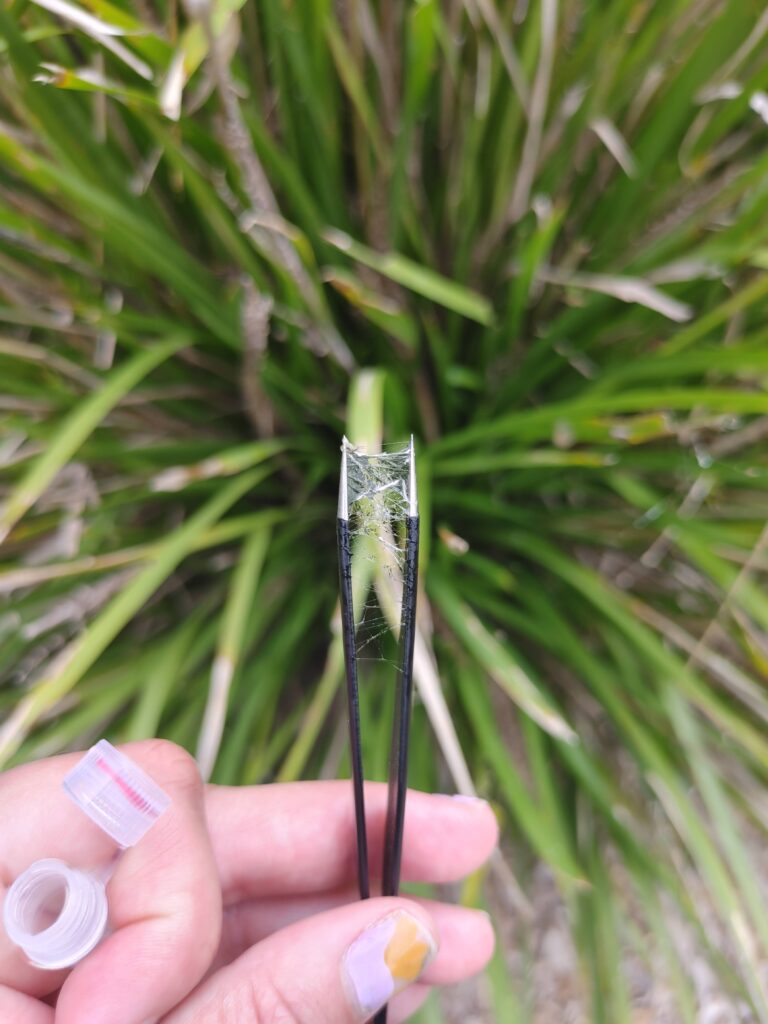 Mercedes Burns collects silk from a Saint Andrew’s cross spider in Australia. (Photo by Mercedes Burns)
A: Probably not. Spider-Man producing silk from his wrists is weird from a biological perspective. It would make more sense if the silk came from his feet, because spinnerets in spiders develop somewhat like a leg, but humans really do not have an equivalent to the spinnerets.
I know a lot about silks, because one of my research projects is focused on sticky proteins that arthropods, including spiders, produce to capture prey. The proteins that spiders make to produce their webs are a unique class of proteins called spidroins.
Spidroins are made up of proteins that form chains. Spiders make these building blocks, which have to align with each other as they are extruded through the spinnerets. The spinnerets contain many little glands where spiders can press out the particular protein that the silk glands produce.
Hypothetically, if you were trying to control the translation of silk proteins in a spider, one way you could do that would be with siRNAs, which could bind to the mRNA and keep the protein from being made—although this would be extremely difficult to do in practice.
Q: Why would it be so difficult to replicate Spider-Man’s web?
A: The silk Spider-Man produces from his wrists is a really sticky, stretchy mass that is also strong. He uses it to stick to surfaces, swing, wrap enemies so that they are restrained without being harmed, and perform other functions. It would be difficult to replicate this material because of how many functions it has.
In reality, spiders make many kinds of silk: some make more than 10 types. Each type has a particular job, such as for wrapping eggs or producing a covering around the eggs. The silks that are probably most important to Spider-Man are flagelliform silk and aggregate spidroin. Flagelliform silk is really stretchy. In a spider web, it forms the capture spiral, the circular part of an orb-weaver’s web. Aggregate spidroin is the sticky part of the capture spiral.
Q: What was scientifically accurate about the explanation Ned Leeds, Spider-Man’s best friend, gave of the mechanical web shooters?
A: Ned asks Spider-Man what material is in Spider-Man’s web shooters. Ned suggests that if it is a synthetic biomaterial, it is probably a liquid polymer inside the web shooters that becomes a fiber. He also suggests that the shearing forces from pressing the material out of the web shooter cause the liquid to become a polymer.
That was spot on.
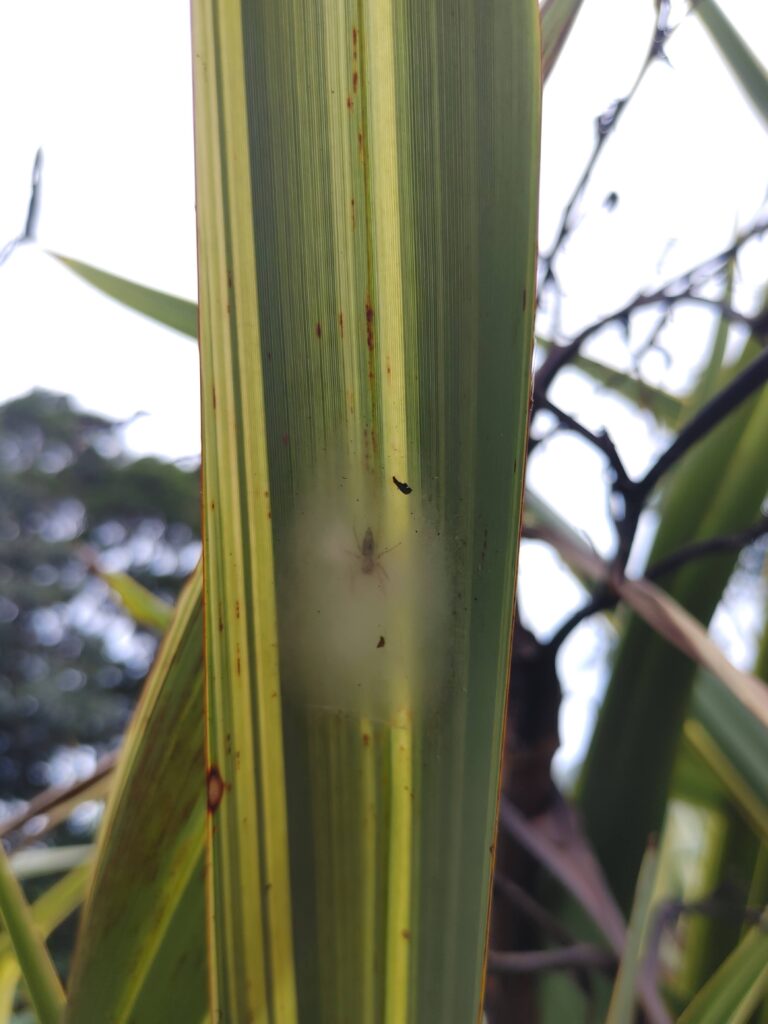
 Spiders use their silk for many purposes. Left: A nursery web spider in its silk hideaway. Right: A fishing spider carries a silk-wrapped egg sac. (Photos by Mercedes Burns)
Inside the glands, the building blocks for spider silk exist as a liquid called dope. The glands’ pH becomes more acidic, which triggers the protein building blocks to start lining up. The dope is also physically pressed through spigots within the spinnerets, and the mechanical force gets the protein into the appropriate conformation. What comes out is a fiber made of blocks of protein.
The web shooters work in a way that could provide the necessary mechanical force to allow a liquid to become a fiber. Ned’s reasoning about a liquid becoming a polymer and then becoming a fiber was remarkably similar to how these biomaterials are described in the scientific literature.
The mystery is the actual material. They know it would be some sort of molecule that polymerizes—that has units that join together as they leave the device. The specific molecule used by Spider-Man remains fictional and proprietary to the story.
Q: How do Spider-Man’s web shooters relate to the way he uses his powers?
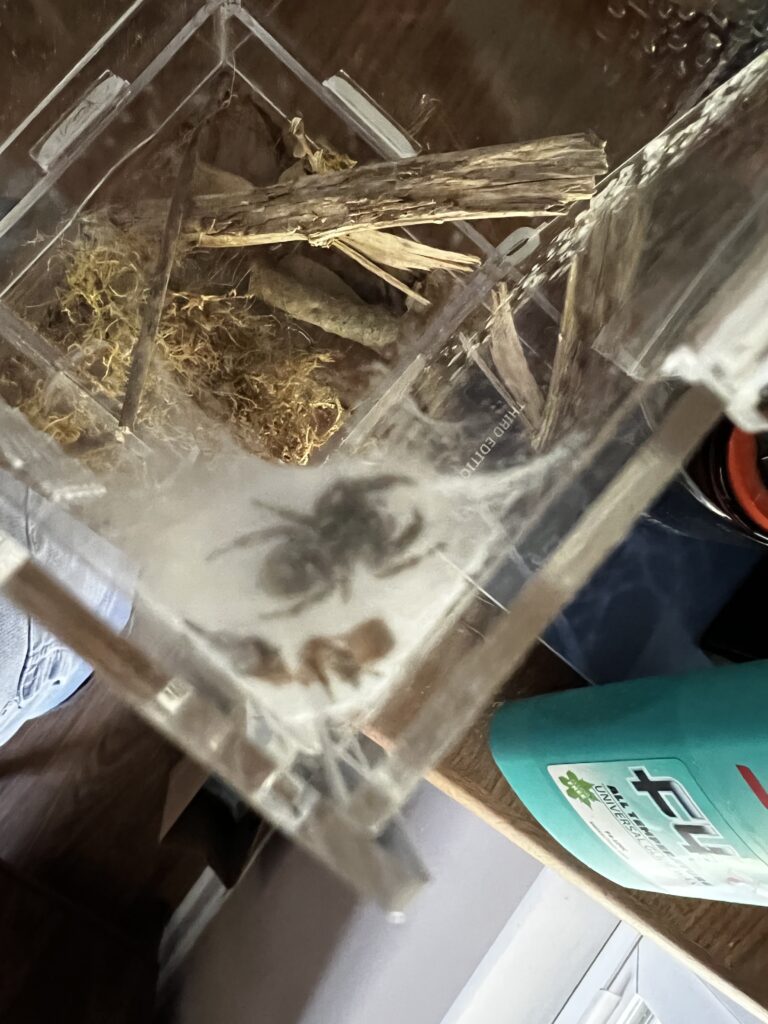 This jumping spider has spun itself a silk hammock in preparation for molting. (Photo by Ryan Bacon, Ph.D. ’26)
A: I am impressed with how Spider-Man learns his own body and his unique way of using his powers in this iteration. His web shooters allow him to work with the police to apprehend criminals without killing them. He can hold people up, restrain them, and throw things in their path. The ingenuity of his use of silk is really cool, because he is using it for good. Spiders are also an example of animals creating structures for good. They live in our houses and feed on pests that we do not like, so they are providing a service for us. In Spider-Man’s case, a human is using similar abilities to protect others.
Q: Is there anything real about the scene where Spider-Man wakes up in a spider cocoon, particularly his black eyes?
A: Yes, there are spiders that produce silk cocoons, such as jumping spiders. When they are getting ready to molt and grow larger, they will often create a little sling or hammock for themselves and surround themselves with silk for protection.
The black eyes, however, are probably a visual effect intended to make Spider-Man look more spider-like. Most spiders probably have poor vision. Their eyes do not have a pupil that focuses in the same way human eyes do.
Q: The trailer hints that Spider-Man is going through the life cycle of a spider. Does this mean Spider-Man will die?
A: I hope not, because for Peter Parker it would be a very short life. There is a lot of variation among spiders. The order of arachnids that includes spiders is vast, with roughly 70,000 species. Some are very long-lived, especially compared to other arthropods like insects and crustaceans. For species that live a long time, such as tarantulas and trapdoor spiders, females typically live longer than males, sometimes up to 30 years.
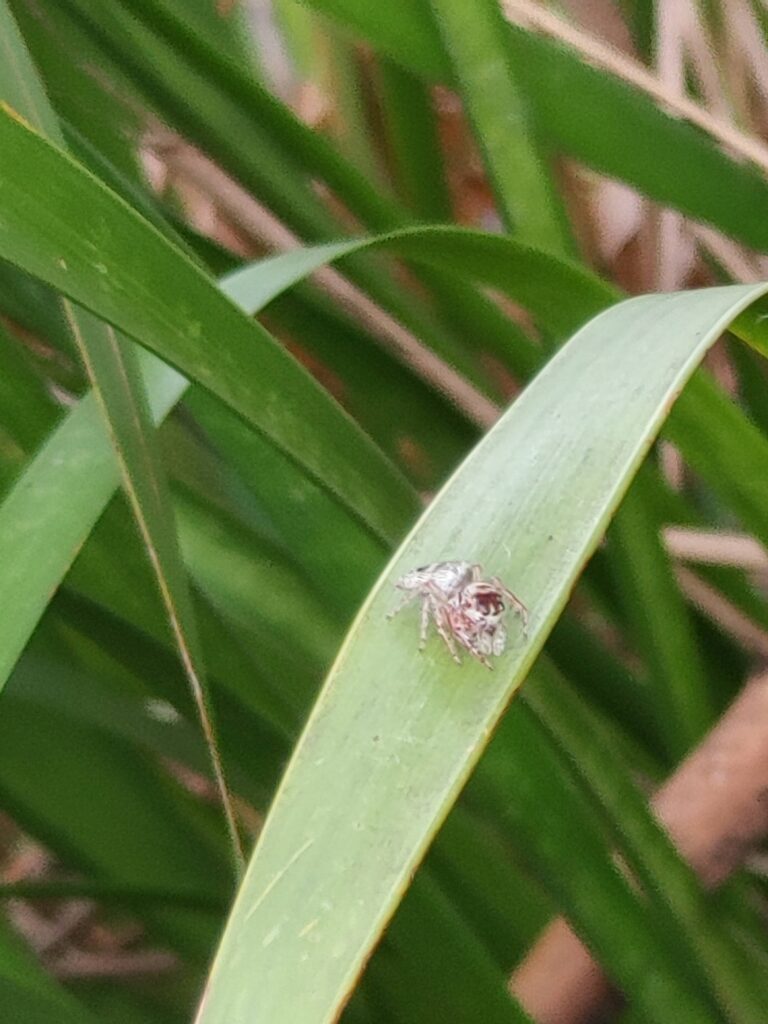 Jumping spiders like this one lay out a “dragline” of silk as they move about, to catch themselves in case of an unexpected fall. (Photo by Mercedes Burns)
Peter Parker is male, however, and many male spiders have incredibly short lives. In many species, males do not survive a mating encounter. A female may eat a male if she is not reproductively mature or if she is hungry. To the degree that a spider’s life cycle involves periods of seclusion, molting, and getting larger, though, there is some similarity.
Q: Is Spider-Man a jumping spider?
A: Spider-Man seems like a combination of different spiders. The art and emblems on his suit would suggest an orb weaver. Spider-Man does have characteristics that are similar to those of a jumping spider, such as cocooning in response to stress. However, jumping spiders always produce a dragline when they are moving through the environment so they can survive a sudden fall, and Spider-Man fires webs to keep himself from falling. So, Spider-Man’s overall appearance may be more like a garden spider, but some of his capabilities better match a jumping spider.
Q: Why did you like “Spider-Man: No Way Home” better?
A: There was more interaction between Peter and his friends. I really enjoy Zendaya’s version of MJ, Spider-Man’s girlfriend. I also really like Ned as a supporting character. They are extremely intelligent in their own right and are curious about things. I like the depiction of three scientifically curious young people working together.
Some of the other Marvel superheroes have AI, magic, or something else that provides them with insight. Spider-Man has his friends. I like this version of Spider-Man because he gets advice from other superheroes here and there, but he is also figuring things out himself and getting some help from his friends. I think it is cool to have your high school friends as your superhero support group.
Learn more about arachnid research in the Burns Arthropod Evolution Lab.
Posted: August 27, 2026, 2:16 PM