Business—not as usual
At UMBC, entrepreneurship transcends a traditional business education: It empowers scientists, artists, and technologists to transform their expertise into real-world impact. Through business accelerators, ambassador programs, interdisciplinary courses, and other innovation pathways, the university offers many avenues for ideas to flourish.
Kushani Mendis and her labmates have developed novel nanomaterials that could transform biomedical technology. She wants to translate their discoveries into a business opportunity, but initially, wasn’t sure what steps to take. So, early in her chemistry Ph.D. with Zeev Rosenzweig, professor of chemistry and biochemistry, Mendis told him that she wanted to become an entrepreneur—and he jumped at the chance to creatively support her with internal and external resources.
UMBC has no formal business school. Yet it may be one of the best places in the country to learn entrepreneurial thinking—precisely because the best ideas so often come from those with technical expertise rather than MBAs. Also, many UMBC entrepreneurs are motivated by a desire to drive positive social change rather than profit, which is supported by courses on “socialpreneurship.” Overall, the university’s model rests on a simple but powerful dual thesis: 1) Disciplinary excellence paired with an entrepreneurial mindset produces graduates who create real-world impact, and 2) entrepreneurship is for everyone.
Employers repeatedly say they need graduates who excel in communication, creative problem-solving, collaboration, and constructive conflict navigation. Traits like resilience and empathy are in high demand—after all, finding effective solutions often requires understanding problems from another’s perspective. UMBC’s courses and programs deliberately train these skills, which can enhance the success of entrepreneurs—and every UMBC graduate.
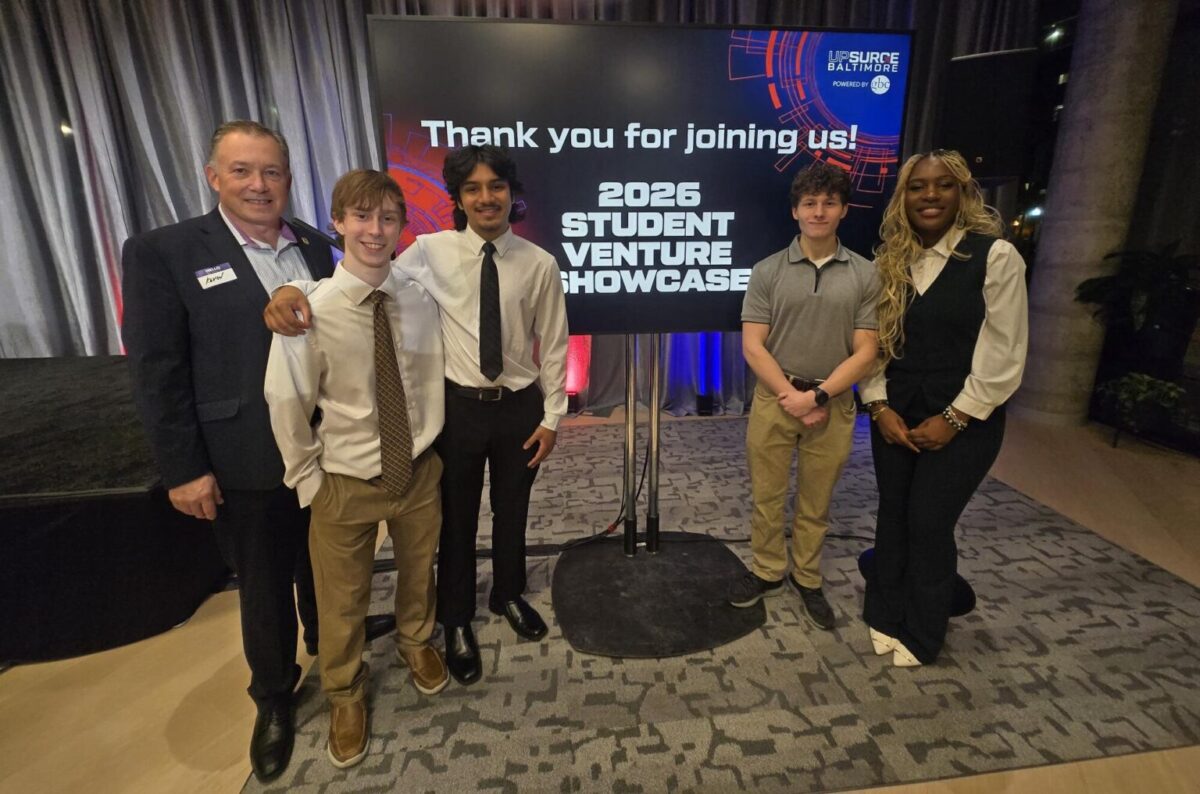 From left to right, Kevin Fulmer, director of the The Alex. Brown Center for Entrepreneurship and Innovation at UMBC, and students Charles Nerad, Abhinav Patel, Aidan Fleischer, and Velma Funebe at the 2026 Maryland Student Venture Showcase in Baltimore. (Photo courtesy of Kevin Fulmer)
The results speak for themselves. Students are winning state and national funding, launching ventures, gaining versatile life skills, and contributing to Maryland’s innovation economy. This spring, two UMBC student teams—iBraid and StrikeSense—each received $50,000 Pava LePere Innovation Awards. Others have advanced through the university’s Summer Launchpad accelerator and secured funding totaling more than $300,000 in the past three years.
An entrepreneurial environment
The roots of UMBC’s entrepreneurship emphasis trace back to 2000, with the founding of the Alex. Brown Center for Entrepreneurship and Innovation. Initially led by Vivian Armour and supported by Constellation Energy Group and the Bearman Foundation, the center took off in 2006 the Kauffman Foundation awarded funds to a small cohort of universities including UMBC, as well as Brown, Carnegie Mellon, Arizona State, and Purdue, to further their entrepreneurship efforts. Armour invited Gib Mason ’95, economics, a serial entrepreneur who had been guest lecturing at UMBC, to help steward UMBC’s $2 million Kauffman award.
“Kauffman’s research had shown that it wasn’t the business school students bringing entrepreneurial ideas to the marketplace,” Mason recalls. “It was the engineers and the tech guys and gals.” The foundation’s premise was that exposing disciplinary experts to entrepreneurial environments could help them develop and commercialize new ideas, he explains.
That initiative led to the creation of UMBC’s minor in Entrepreneurship and Innovation. The 18-credit program combines two core entrepreneurship courses with 12 credits from designated courses across UMBC’s three colleges, where faculty have infused entrepreneurial principles into existing major curricula. Today, more than 70 courses in biology, public health, information systems, art, and engineering count toward the minor, making it broadly accessible.
 Gib Mason (standing) leads entrepreneurship programming at the UMBC Training Centers. (Marlayna Demond ’11/UMBC)
The center turned 25 this academic year. Kevin Fulmer, its first full-time director and a lifelong entrepreneur, has spent the past five years expanding its reach and visibility. “Before there were any full-time staff, awareness of the center was fairly minimal,” he says. Under his leadership, Introduction to Entrepreneurship—which fills up quickly every semester—was approved as a General Education Program course. The center also launched a student ambassador program, and now six students promote events, support programming, and serve as peer mentors. Faculty can apply for funding to embed entrepreneurial thinking in their courses, and designated faculty fellows from each college are designing discipline-specific tracks within the minor. “We’re trying to make it as accessible for as many students as possible,” Fulmer explains.
A separate master’s in Entrepreneurship, Innovation, and Leadership—developed by Mason and offered through UMBC’s Division of Professional Studies—has served working professionals since 2019 and draws on the same philosophy of practical application. Meanwhile, the center’s summer Launchpad accelerator has supported more than 20 student ventures since 2022; participants receive an $8,000 stipend to dedicate 10-weeks to full-time customer discovery and problem validation. iBraid and StrikeSense, the Maryland award winners, emerged from the accelerator’s pipeline. Additional opportunities include the fall Idea and Innovation Challenge (with a popular social-impact category) and the spring Cangialosi Business Innovation Competition for more developed concepts.
All of this exists without a traditional business school. Instead, UMBC has built an ecosystem that meets students where they are—inside their technical and creative majors—and provides the tools to translate discovery into impact. “Entrepreneurship is for everyone,” the Alex. Brown Center’s website proclaims, regardless of major or career aspirations.
Not-so-risky business

Entrepreneurship at UMBC emphasizes mindset over venture creation alone. “It’s really just about solving problems and using an entrepreneurial mindset to do that,” Fulmer stresses.
Studies suggest that only 30 to 50 percent of graduates nationally are employed in roles directly related to their specific field of study, Fulmer notes. “You may have all the technical skills in the world, but not get these life skills from your major,” he adds. UMBC’s approach prepares students for diverse careers—launching startups, innovating inside a corporation, teaching, or pursuing research—by developing empathy and resilience and building creative problem-solving and communication skills.
Mason challenges the stereotype that entrepreneurs are reckless risk takers. “Most entrepreneurs are constantly making informed decisions to mitigate risks,” he says. He draws from childhood summers working on his grandfather’s Kansas farm, where he earned money from “his” acres of wheat—until one year a tornado destroyed the crop. The experience taught him that “there’s a lot that you can control and a lot that you can’t.” True entrepreneurs, he says, take calculated risks and then work diligently to reduce them.
Many UMBC students are drawn to “socialpreneurship”—ventures that solve societal problems rather than chase profit. “Students today seem especially geared toward trying to do things for social impact,” Mason says. The center’s social-impact track in competitions reflects this, and courses like Creative Problem Solving and The Socialpreneur have led to tangible outcomes, such as OCA Mocha, a coffee shop connecting UMBC with the Baltimore community.
Braiding the future
Velma Funebe, a public health major, embodies this orientation. Her venture, iBraid, uses augmented reality to help users part and braid their own hair—transforming protective styling that can become a multi-day ordeal into a more manageable process. Inspired by braiding her own hair since age 11 and running a professional braiding business since ninth grade, Funebe validated demand via TikTok and conversations. “I realized it was a major problem because so many people struggled with it,” she says. “I couldn’t find any solutions out there.”
As an Entrepreneurship Ambassador, she now supports programming and events like 1 Million Cups, another Kauffman Foundation initiative where entrepreneurs pitch ideas and get feedback. The Baltimore edition meets at OCA Mocha twice monthly. “The scariest part is when the idea is not just in your brain, but other people hear it,” Funebe says. “But I think it’s a great space to get feedback and say, ‘Okay, I can live through an application rejection.’”
Funebe’s faith helps anchor her while she balances classes, leadership in the Public Health Council of Majors, weekend braiding appointments, and venture development. iBraid has gained strong traction: a second-place finish in UMBC’s Idea and Innovation Challenge, the Pava LaPere Innovation Award, a waitlist approaching 4,000, and more than 10,000 TikTok followers. Beta testing is underway, supported in part by two UMBC data science graduate fellows through the Maryland New Venture program at bwtech@UMBC, a business incubator adjacent to campus. iBraid’s momentum continued to build at Maryland New Venture Pitch Night ’26, where Funebe took third place and received the Audience Choice Visionary Award.
“The Alex. Brown Center has played an essential role in helping me to grow my confidence,” she says. To others considering giving entrepreneurship a try, she says, “Don’t be afraid to fail—at least you get a result out of failing, and can learn a lot from it.”
Striking while it’s hot
Abhinav Patel, Charles Nerad, and Aidan Fleischer, co-founders of StrikeSense, channeled frustration with their Taekwondo training into innovation. In competition, expensive electronic wearables detect hits and record scores, but most athletes lack access to that equipment in practice. “I had the idea for a sparring vest with a health bar like something from a video game,” Nerad says.
The team developed an affordable sensor attachment that turns any existing sparring vest into a smart vest capable of detecting and scoring hits, with a gamified “health bar” interface. After placing second in the 2025 Cangialosi Business Innovation Competition, they joined the summer Launchpad program.

“All of the support we have gotten from UMBC has been instrumental, and we wouldn’t be where we are today without it.” Patel notes. Mentors like Donald Miner ’06, Ph.D. 2010, computer science; and Chris Ewing, an “entrepreneur in residence” at bwtech@UMBC, and especially Fulmer provided guidance: “Without him, we would not have had the encouragement to continue, the accountability to work hard, and the guidance to grow,” Nerad adds.
They are now refining software and preparing a pilot program with local dojos. “There is no better time to take a chance on an idea than right now,” Nerad advises. “You are surrounded by thousands of brilliant minds at UMBC, and have access to dedicated mentors who genuinely want you to succeed.”
And Kushani Mendis is now thriving at the intersection of research and entrepreneurship. She’s participated in the Center for Sustainable Nanotechnology, represented UMBC in the regional 3-Minute Thesis competition, and completed training at Brookhaven National Lab through UMBC’s Chemistry and Biology Interface program. To younger scientists, she says: “Being a scientist does not have to mean being confined in a lab. You are a human who has a lot of potential that you can give out to the community.”
As Fulmer puts it, “We’ve always been really great at UMBC at training students’ analytical, left-brain development—but our entrepreneurship programs are promoting right-brain skills as well, which are just as important.”
Extending the ecosystem
Faculty, alumni, and the broader community benefit, too. bwtech@UMBC offers state-of-the-art labs and work spaces, educational programming, mentorship, and industry connections. Many alumni and community members have built businesses there that contribute jobs and innovative products and services to the regional economy.
 bwtech@UMBC, located adjacent to main campus, supports Maryland entrepreneurs at every stage of business growth. (Marlayna Demond ’11/UMBC)
In addition, the Entrepreneurial Skills Training program for faculty in the College of Natural and Mathematical Sciences helps principal investigators apply strategic, startup-style thinking to manage their multi-million-dollar research labs. “They’re running a business, whether they like it or not,” says Mason, who originally designed the program that’s now run by Fulmer. “They’re hiring people, buying resources, creating stuff.”
Finally, the new Entrepreneurial Learning Lab (ELL) pairs faculty with trained students to evaluate research for commercialization potential—without requiring faculty to become full-time CEOs. The inaugural cohort drew strong interest: 23 faculty applied for 10 spots alongside 54 student applications. “We’re not trying to change what faculty do in terms of research and teaching,” Fulmer explains, “but while they’re doing that, think about potential impact.”
This diverse array of entry points—from minors and master’s programs to accelerators, competitions, and faculty-student collaborations—deliberately creates an inclusive entrepreneurial ecosystem. Ideas from any discipline or career stage have room to grow.
The bigger picture
UMBC’s entrepreneurial ecosystem does more than launch student ventures; it strengthens Maryland’s innovation economy, particularly in biotech, health tech, and advanced materials. The university’s strengths in these areas—coupled with proximity to federal labs and funding—creates what Fulmer calls a “target-rich environment.” Many Launchpad teams naturally transition into bwtech@UMBC’s incubation programs, forming a clear pathway from classroom concept to scalable company.
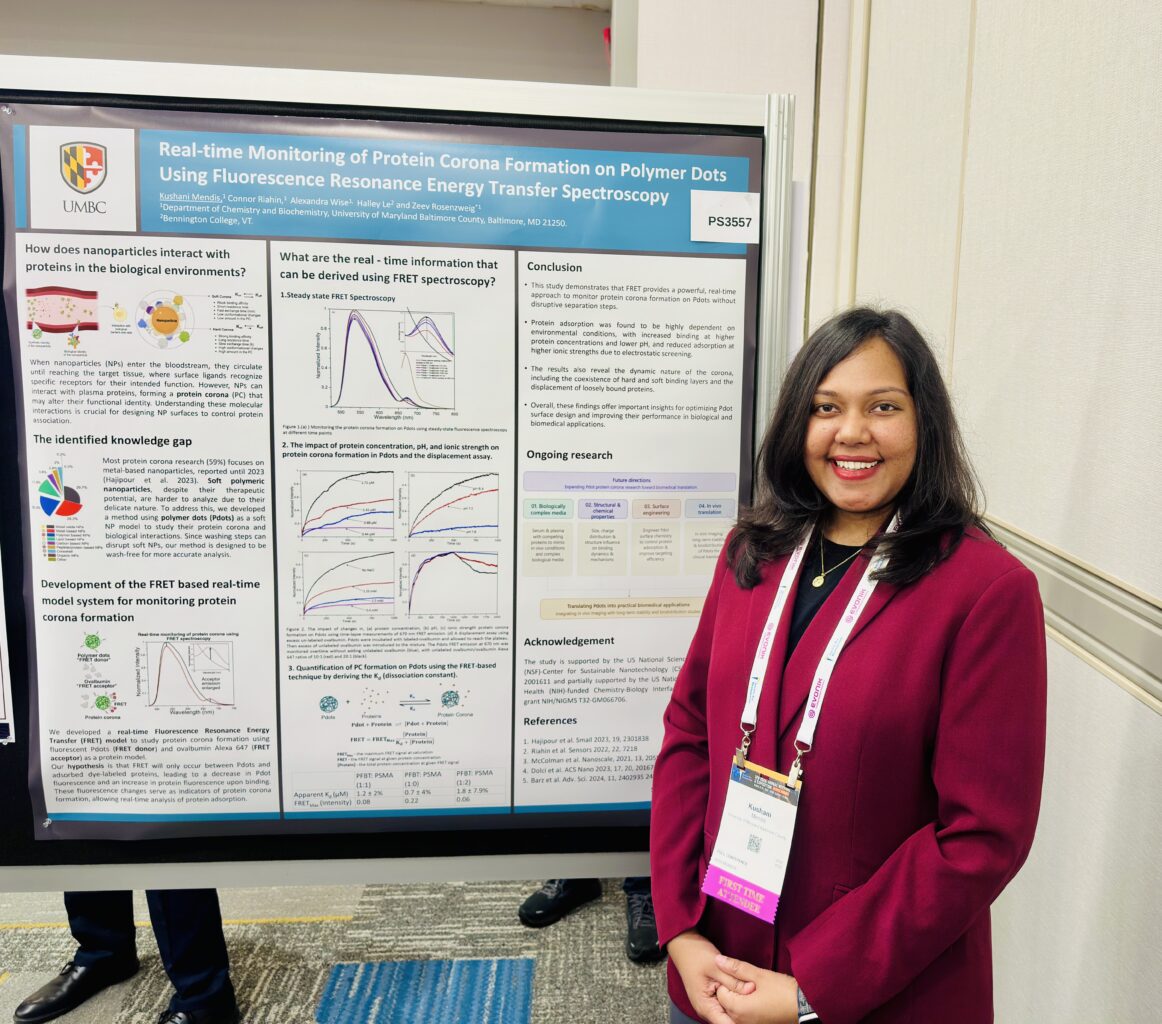 Kushani Mendis presented her research at the 2026 Society for Biomaterials Annual Meeting. (Courtesy of Mendis)
Today, Mendis’s schedule is packed with interviews of biomedical technology researchers in government, academia, and industry. Her probing questions are helping determine whether her lab’s novel nanomaterials have commercial potential. Rosenzweig’s encouragement and programs like the National Science Foundation Innovation Corps (I-Corps), which trains scientists to translate research into societal impact, have been key. She is thriving, balancing independent laboratory research, teaching and mentoring undergraduates, and her entrepreneurial work; she even occasionally finds time to engage her artistic side.
Whether or not students like Mendis ultimately launch businesses, at UMBC, they gain versatile skills—problem-solving, communication, empathy, and resilience—that will serve them across diverse careers. Here, entrepreneurial thinking is not an elective add-on but foundational preparation for an unpredictable world.
“UMBC’s model—technical excellence plus mindset training—prepares graduates to innovate anywhere,” Fulmer says, “making the university a powerful driver of Maryland’s future.”
Posted: June 12, 2026, 11:42 AM