Inaugural “MyRCA” interdisciplinary faculty cohort empowers researchers to bring their work to life
UMBC’s new Make Your Research Come Alive (MyRCA) program is helping faculty translate their scholarship into compelling stories that resonate across disciplines, sectors, and audiences. Launched in November 2025, the program wrapped up its inaugural cohort with a May showcase.
“We created the MyRCA program to help faculty strengthen their research communication skills and effectively convey the significance and real-world impact of their work beyond traditional academic audiences and funding pathways,” says Christine Mallinson, assistant vice president for research and scholarly impact. “It also encourages faculty to think strategically and creatively about visibility, partnerships, collaboration, and long-term impact,” she adds.
Led by the Division of Research and Creative Achievement in partnership with the Office of Institutional Advancement, MyRCA brought together 14 faculty members for twice-monthly workshops and working group sessions, a January mini-retreat, and the culminating showcase. The program focused on identifying and articulating research impact, translating specialized scholarship for broad audiences, developing compelling narratives and pitches, understanding funding landscapes, exploring pathways for engagement with corporate, community, and philanthropic partners, and strengthening interdisciplinary collaboration.
“The value of this program is in connecting with each other,” cohort member Foad Hamidi, associate professor of information systems, shared at the showcase. “Strong research communication and collaboration can help our research come alive,” adds Dong Li, another cohort member and assistant professor of computer science and electrical engineering. Li added, “We are not just researchers, we are telling our story to our audience.”
The value of connection
The program intentionally grouped faculty into smaller interdisciplinary teams organized around broad themes such as health, youth, and the environment. These connections quickly sparked new ideas and collaborations.
For instance, Lauren Clay, professor and chair of emergency and disaster health systems, connected with Li, after learning about his work on wearable health-monitoring devices. Clay wondered how Li’s technology could support a colleague’s research on paramedic response during extreme heat events, including monitoring heat stroke risks for marathon runners.
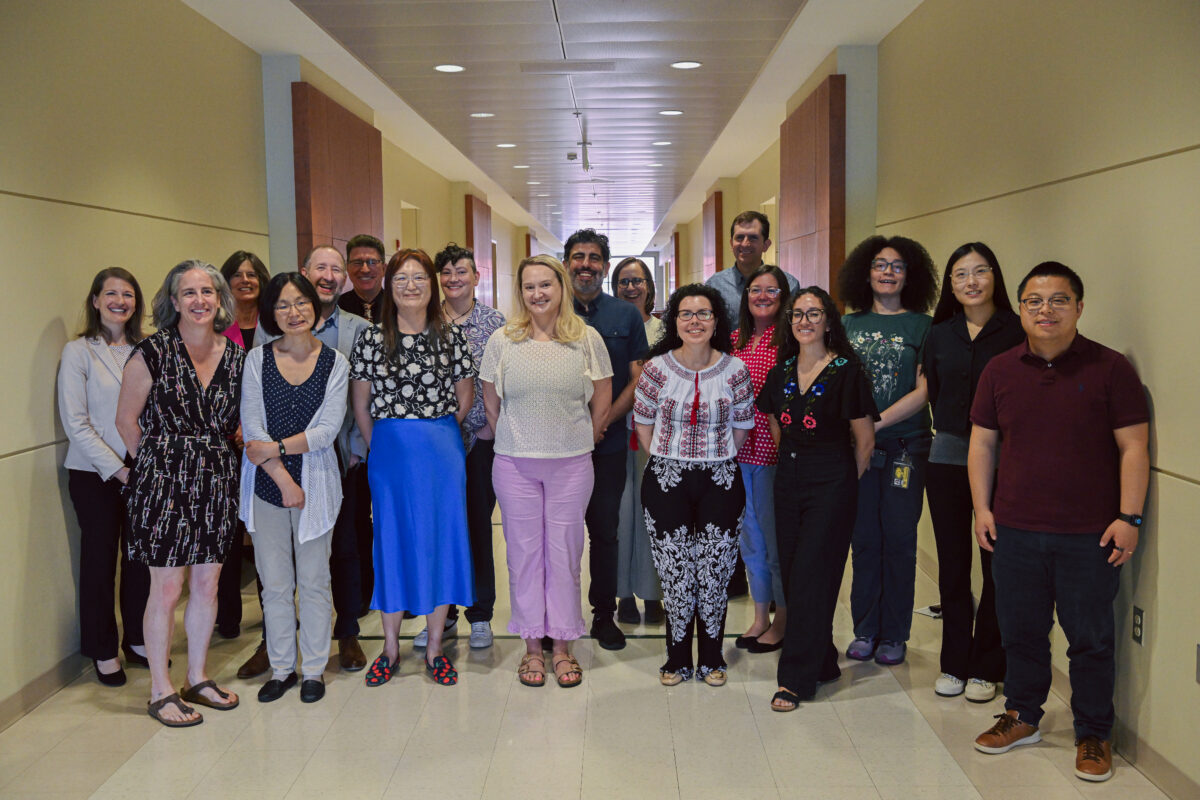 The inaugural MyRCA cohort and program organizers, left to right: Christine Mallinson, Ellen Kohl, Donna Ruginski, Karen Chen, Brian Kaufman, Karl Steiner, Shuling Yang, Sophie Comer-Warner, Amy Tondreau, Foad Hamidi, Linda Kidder Yarlott, Marie Christine-Daniel, Don Engel, Lauren Clay, Gabriella Weiss, Rebecca Williams, Yiwen Hu, Dong Li. Not pictured: Charissa Cheah.
A group including Gabriella Weiss, postdoctoral researcher with the Center for Spaces Sciences and Technology; Marie-Christine Daniel, associate professor of chemistry and biochemistry; and Sophie Comer-Warner, assistant professor of geography and environmental systems, examined remediation strategies for microplastics, heavy metals, and volatile organic compounds with a focus on wetlands. Their collaboration pointed to promising local funding opportunities with Maryland Sea Grant and Chesapeake Bay organizations.
Ellen Kohl, assistant professor of geography and environmental systems, strengthened a new science communication course with the skills she gained, and Shuling Yang, assistant professor of education, advanced her research using generative AI and Chinese pop music for biliteracy development. Brian Kaufman, professor of music, built on the UMBC Create Music Festival, which brings collaborative problem-solving into a typically performance-based discipline.
By the showcase, participants had developed polished pitches, public-facing materials, and broader impact narratives ready for funding proposals, donor outreach, and the media. Each received $500 in research support, along with new cross-campus and external connections.
MyRCA stretches faculty beyond their comfort zones
Mallinson has been excited to see the 14 faculty “stretch beyond their usual disciplinary comfort zones and immediately begin putting the skills and approaches they were learning into practice—developing cross-disciplinary proposals, crafting pitches, appearing in videos and podcasts, participating in panels, and bringing what they learned in the program back to their graduate students and colleagues.”
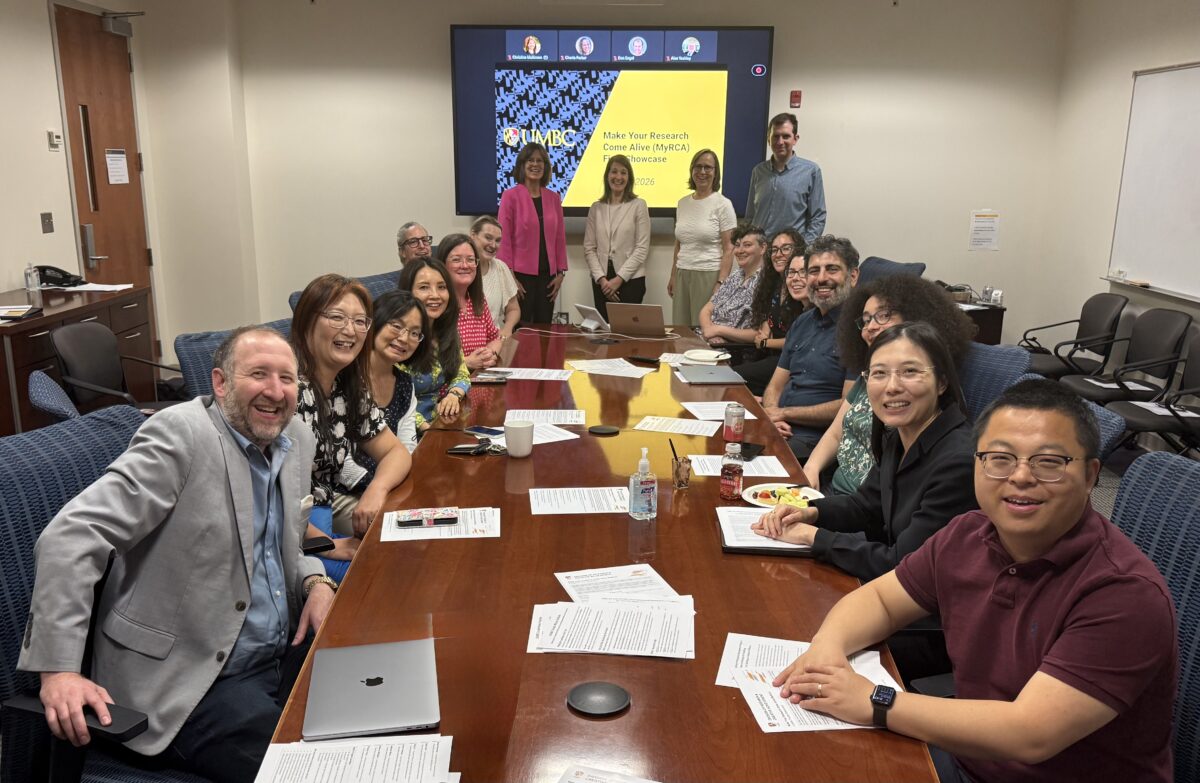 The inaugural MyRCA cohort shared progress and celebrated their accomplishments at a showcase event in May. (Photo by Karl Steiner)
Linda Kidder Yarlott, associate director for corporate research partnerships, highlighted the value of the partnership between the Division of Research and Creative Achievement and the Office of Institutional Advancement. “While federal funding agencies are looking for highly technical, methodology-driven proposals, it’s visionary, outcome-oriented narratives that clearly articulate the human impact and real-world return on investment that entice corporate and philanthropic partners,” Yarlott says.
Yarlott and Jocelyn Kehl, major gift officer for the College of Natural and Mathematical Sciences, worked with the cohort on practical skills—from strategic networking and optimizing LinkedIn profiles to crafting stories that resonate with donors and foundations. “Mentoring this cohort has been an incredibly rewarding experience, culminating in a spectacular program showcase where faculty teams powerfully demonstrated new communication skills that will help unlock new philanthropic pathways,” Yarlott shares.
For more information and to learn about the full 2025 – 2026 cohort, visit research.umbc.edu/myrca.
Posted: June 1, 2026, 3:17 PM