‘Why do I need to know this?’ Padhu Seshaiyer, Ph.D. ’98, on why math matters
More than 20 years ago, Padmanabhan “Padhu” Seshaiyer, Ph.D. ’98, applied mathematics, observed researchers stretching aneurysm tissue samples in a neighboring lab, generating a dataset to describe the resilience of artery walls under varying conditions. Those mathematical computations could then be used to help doctors predict how likely an aneurysm in a patient’s artery was to rupture and choose the safest effective treatment—potentially saving lives.
For Seshaiyer, that exposure was a revelation. “Mathematics has a place to change people’s lives,” he realized. Today, as a professor of mathematical sciences at George Mason University (GMU), he directs the Center for Outreach in Mathematics Professional Learning and Educational Technology (COMPLETE). Previously, he also directed the STEM Accelerator Program for the College of Science at GMU, where he later served as associate dean for academic affairs. Both initiatives embody his mission: reform STEM education so every student experiences that same powerful connection to real-world impact.
Learning from mistakes
Seshaiyer grew up in India, earning a bachelor’s degree in electrical and electronics engineering and a master’s in mathematics. He loved math but, like many kids, kept asking, “Why do I need to know this?” Seeking applied graduate programs abroad, he chose UMBC in 1993 for its strong faculty and focus on applied math research—plus a presidential scholarship that made it possible. “UMBC had some really top-notch professors, and in particular, really good people doing applied mathematics,” he recalls.
At UMBC, mentors lit Seshaiyer’s path in research and teaching. With Manil Suri, professor of mathematics,he studied finite element methods, which break a complex problem into many simple pieces, solve each separately, then combine the results to approximate the behavior of the whole. His scholarship didn’t require him to teach, but he pursued classroom opportunities anyway to enrich his experience—which they certainly did. For example, “four into eight” means multiplication in Indian English, but division to American students. “Unless you’re in front of the classroom, make that mistake, and learn from it—well, that’s how you become a good teacher,” he reflects.
From “how” to “why”
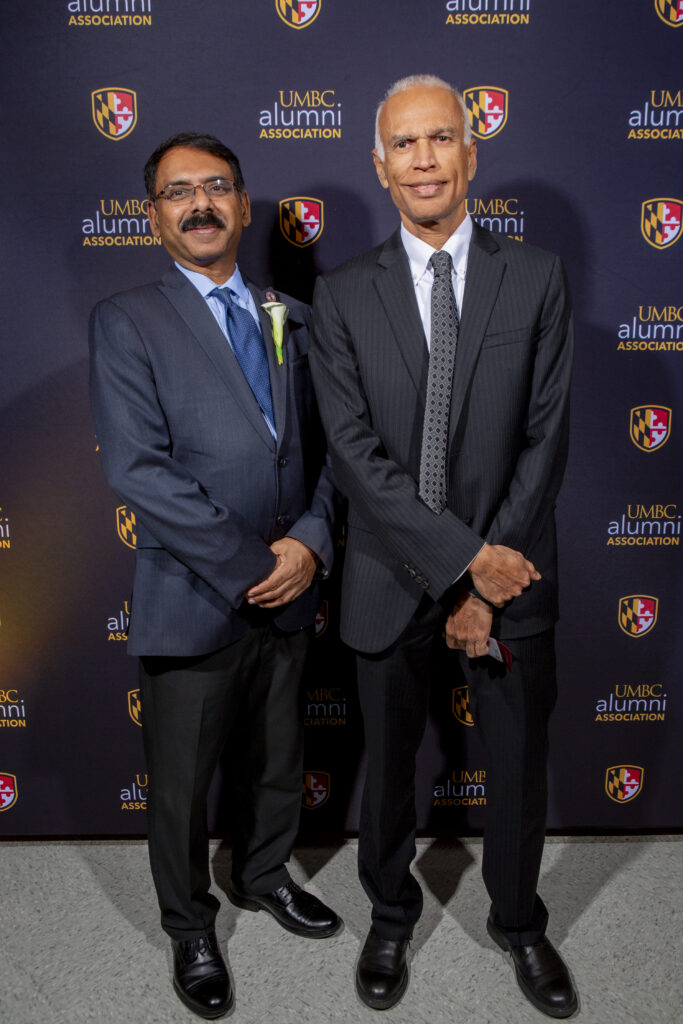 Padmanabhan Seshaiyer (left) with Manil Suri, one of his UMBC mentors, at the 2024 UMBC Alumni Awards. (Photo by Jill Fannon, M.F.A. ’11)
A course with former UMBC engineering professor Jay Humphrey exposed Seshaiyer to biomechanics. Impressed, Humphrey later recruited him for a postdoctoral position at Texas A&M University. It was there that Seshaiyer observed the aneurysm experiments that sparked his pivot to education reform. Traditional teaching, he had seen, often skipped the “why,” leaving students disengaged.
“There was a gap,” he says, “between understanding how to do the mathematics and the why.” That idea inspired him to found the COMPLETE Center, which has trained over 2,500 teachers since 2010 in blending procedural skills with conceptual understanding. The training is grounded in evidence-based pedagogy, such as the 5E instructional model: engage, explore, explain, elaborate, and evaluate.
“Students are not just consumers of mathematics,” Seshaiyer emphasizes. “They are producers of mathematics. It’s important to treat them as producers.” He starts lessons by making connections to real life. When teaching conic sections—the various cross-section shapes created if one slices through a cone—he begins with GPS satellites, which draw intersecting circles to pinpoint a location: “Now, I just told you why we need to learn what we’re learning.”
UMBC has emphasized this same shift toward relevance and active discovery in its own curriculum. MATH 110: Math in Action, launched in fall 2023, is a lab-based class for non-STEM majors that replaces traditional lectures with hands-on experiments—such as tracking brine shrimp movement to explore velocity or using clinometers to measure real-world heights—to demonstrate how math permeates everyday life. By encouraging students to investigate, analyze data, and forge their own connections, the course helps transform math anxiety into curiosity and shows that understanding the “why” can make the subject engaging and empowering for all learners.
Student-led discovery
Seshaiyer has realized that reforming mathematics education at the college level is insufficient, though. As chair of Virginia’s STEM Advisory Board, he spearheaded the state’s first K – 12 data science standards, in part responding to employer demands for a data science-ready workforce. Data science sits at the intersection of statistical reasoning, mathematical foundations, and computational thinking and may not carry the emotional baggage that straight-up “math” does for some students, Seshaiyer explains.
In Virginia’s data science curricula, students follow a hands-on cycle: acquire data, process it, visualize trends, generate a model, use it to predict future results, and communicate the findings. Students often get to choose their own projects, which have included everything from river pollution to rates of depression among high schoolers.
The process follows a framework Seshaiyer developed called the “five Cs.” It starts with “context” (a real-world problem), followed by creating a meaningful “curriculum” that incorporates integrated “content” presented via effective teaching “concepts.” Throughout the process, the teacher cultivates student “competencies” including communication skills, collaboration, critical thinking, and creativity.
Sometimes, the best thing a teacher can do to foster these skills is step away: A high school student interested in modeling the spread of Zika virus was in Seshaiyer’s office when an undergraduate student arrived who was interested in gang violence in Puerto Rico. Seshaiyer stepped out (ostensibly for a cup of coffee) and encouraged the two to discuss their ideas. When he returned, the two students had come up with modes of gang violence “transmission” that paralleled the ways Zika spreads. The research eventually yielded a published paper on which both students were co-authors.

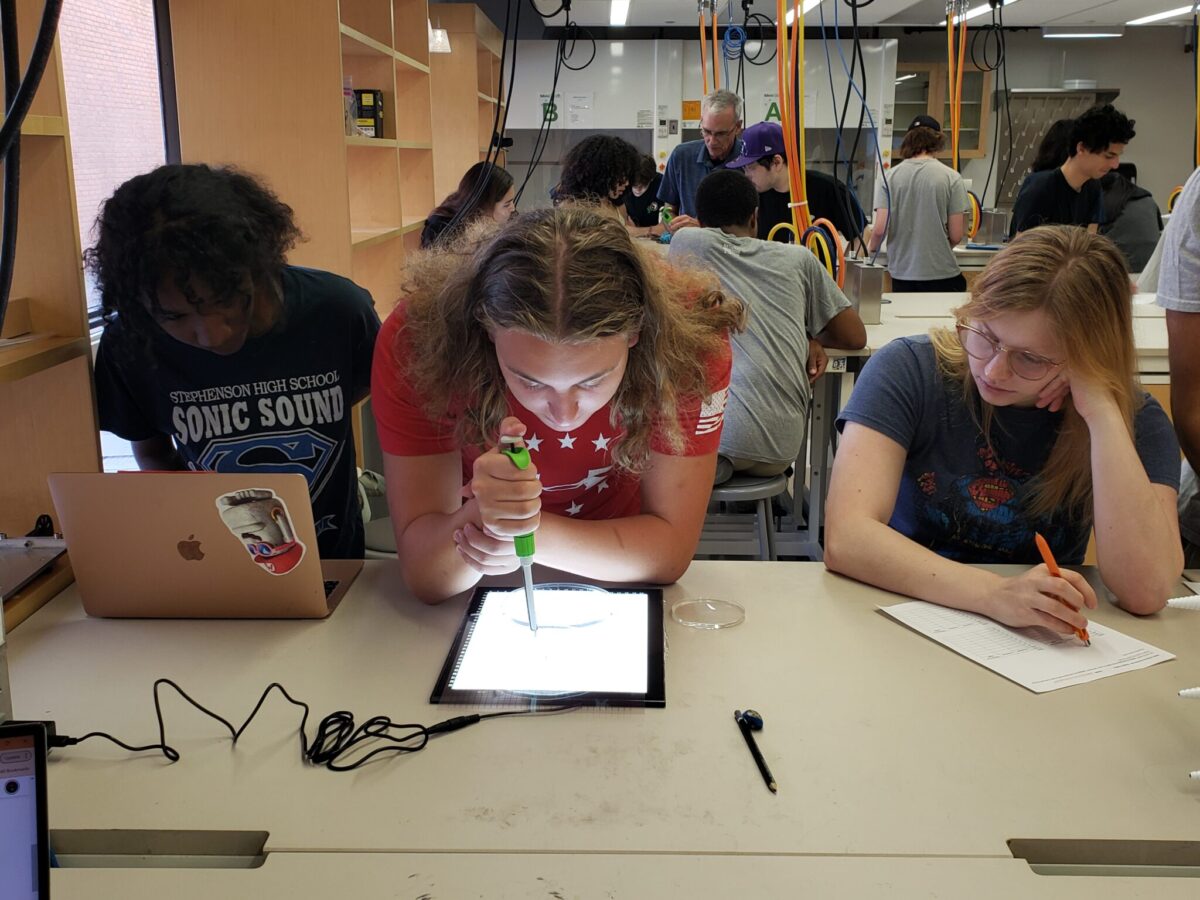 Left: Students in the Building STEPs program run a trial in a lab activity about potential and kinetic energy. (Photo by Brad Ziegler/UMBC) Right: Students in MATH 110: Math in Action record the movements of brine shrimp. (Photo by Sarah Hansen, M.S. ’15/UMBC)
“Mathematics for impact”
Seshaiyer’s experiences at UMBC remain foundational, including a personal relationship with president emeritus (and fellow mathematician) Freeman Hrabowski, with whom he’s shared the stage for keynote addresses. “UMBC has definitely taught me so much,” says Seshaiyer, who received a 2024 Outstanding Alumni Award from the UMBC Alumni Association Board of Directors.
Recently nominated for Virginia’s Math Educator of the Year, his core passion—“mathematics for impact”—endures. UMBC is extending that same impact into K – 12 classrooms through strategic partnerships with Baltimore City high schools. A longstanding collaboration with Building STEPs brings MATH 110-style hands-on labs to rising seniors, helping build math confidence and real-world connections.
Newer partnerships, such as with the Ingenuity Project at Baltimore Polytechnic Institute, include hosting campus visits for students and professional development for teachers and supporting student research in math modeling. These efforts create pipelines for engaged, math-ready learners—proving that when institutions meet students where they are, math can be an exciting path forward rather than an obstacle to overcome.
Posted: January 22, 2026, 2:19 PM